
Usually music in video games sets the mood: it builds tension before a boss fight, makes exploring the world more enjoyable, or turns the final scene into something memorable. But sometimes developers go further and literally build music into the game mechanics. Here it's no longer enough to just listen to the soundtrack: you need to hit the beat, follow the melody, move to the rhythm, or even create your own sound compositions.
We've gathered ten games where music and sound take up far more space than your typical background layer.
Sayonara Wild Hearts

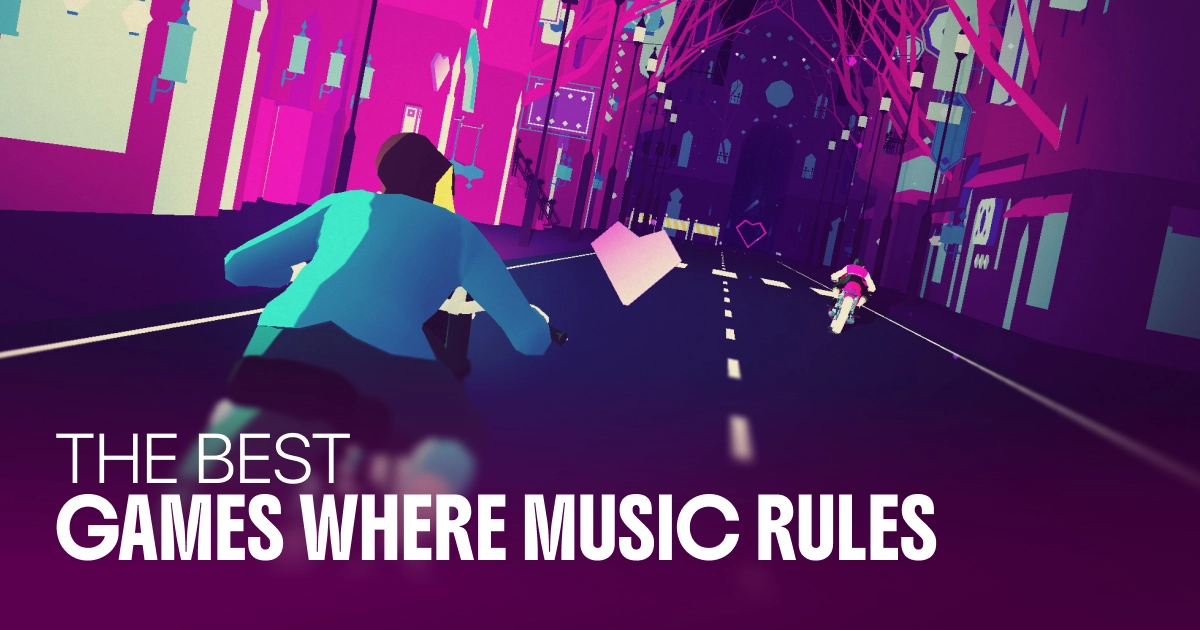
Sayonara Wild Hearts is hard to call a typical music game. It's more like an interactive music video where you control a heroine racing through surreal worlds set to a dynamic pop soundtrack.
You dodge obstacles, collect hearts, pull off tricks, and fight enemies. At the same time, your actions constantly sync with the track: tempo shifts, musical accents, and transitions between song sections become gameplay elements. The music shapes what's happening.
Rhythm Sprout: Sick Beats & Bad Sweets

In Rhythm Sprout, even a regular battle turns into a musical performance. The main character, a tiny sprout named Sprout, sets out to save the candy kingdom, and his sense of rhythm helps him fight enemies.
Attacks, dodges, and other actions need to be performed on beat. The more precisely you hit the rhythm, the more effective your actions become. The game constantly switches up musical styles, introduces new mechanics, and never lets you settle into one tempo. It's a rhythm-action game with a fun story and surprisingly demanding reaction requirements.
Taiko no Tatsujin: Rhythm Festival

Everything here revolves around the Japanese taiko drum. Musical notes appear on screen, and you need to press the right buttons at the right time, mimicking drum hits. Red and blue notes require different actions, and long sequences test not just your sense of rhythm but also your reaction speed.
Rhythm Festival packs a large music library with tracks from anime, games, pop music, and other genres. You can gradually raise the difficulty, compete with other players, and master increasingly intricate rhythmic patterns. Essentially, it's a full arcade music platform.
PATAPON 1+2 REPLAY

In PATAPON, music becomes the primary way to command an entire army. You lead funny one-eyed creatures who go on expeditions, fight enemies, and overcome various obstacles.
But there are no conventional commands here. To order an advance, a defense, or an attack, you need to beat specific rhythmic combinations on drums. How precisely you perform them determines how coordinated your squad acts. If you lose the beat, the army can lose its fighting spirit and stop following orders.
It's an unusual blend of strategy, rhythm game, and tactics where music literally becomes the language you use to talk to your own soldiers.
Just Dance 2025 Edition

In Just Dance, music directly dictates every player action. Dancers appear on screen, and you need to copy their moves to the selected track. The more accurately your movements match, the more points you earn.
The game features popular songs across different genres, and each track comes with its own choreography. Some require simple moves, others force you to constantly shift your body position and memorize complex sequences. To get a good score, you have to become part of the musical number yourself.
Llamasoft: The Jeff Minter Story

This isn't quite a conventional music game but rather an interactive collection of works by Jeff Minter, a developer known for his psychedelic arcade games. Many of his projects are built around vivid visual effects, unusual shapes, and constant motion tightly linked to the audio.
The games and tools where visuals react to music are especially interesting. You can watch sound frequencies and rhythmic changes transform into moving geometric shapes and light patterns. It's a journey through the history of experimental video games where sound and image exist on nearly equal footing.
Thirsty Suitors

In Thirsty Suitors, music becomes part of not just dancing but also combat. The main character Jala returns to her hometown, deals with family conflicts, and meets up with her exes. Some of these encounters turn into unusual turn-based battles.
During fights, you pick attacks and time your actions to rhythmic prompts. Dance sequences get their own spotlight, where you repeat moves and stay on beat. Thanks to this, even hashing out relationship drama can turn into a full musical showdown.
The Pathless

At first glance, The Pathless looks like an adventure game about exploring a large open world. The main character travels across a mysterious island, uses a bow for movement, and gradually cleanses territories of an ancient evil.
But music here is tightly woven into movement. To speed up, you need to hit special targets with arrows, and the rhythm and sequence of actions help maintain a continuous flow of traversal. The soundtrack shifts along with what's happening and amplifies the feeling of speed and freedom. The music and precision of your actions work as one.
Wattam
Wattam offers a completely different approach to interacting with music. It's an unusual adventure game where you meet quirky characters, explore a bright world, and experiment with various interactions.
Many actions are accompanied by musical sounds, and combining characters and objects helps create new sound combinations. There's no standard system of musical challenges or a need to hit a strict beat. Instead, the game invites you to explore the world through sound, movement, and playful combinations. Music becomes part of the very process of interacting with your surroundings.
Ratatan

In Ratatan, music is the foundation of the entire gameplay. The game feels like PATAPON in spirit: you command a whole army of unusual creatures by issuing orders on beat. You need to time attack sequences to send fighters charging in, make them defend, or change formation.
But Ratatan doesn't stop at the music-automaton mechanic. While your squad follows commands, you directly control the main character, choose your position, and decide when to push forward or fall back. If you nail the rhythm, you can trigger a special Fever mode where the music and character behavior change. It's an unusual mix of rhythm game, tactical management, and fast-paced action where a good ear becomes just as useful as quick reflexes.
When the Soundtrack Stops Being Background
Music in video games can be anything: a weapon, a control scheme, a reaction test, or even an investigation tool. Some games make you keep the beat, others turn every movement into part of a musical number, and still others ask you to listen carefully to the world around you.
These are the games that remind us video games can do more than just visuals and controls. Sometimes hearing the right sound is all you need to figure out what to do next. And sometimes one missed beat decides the whole outcome.