
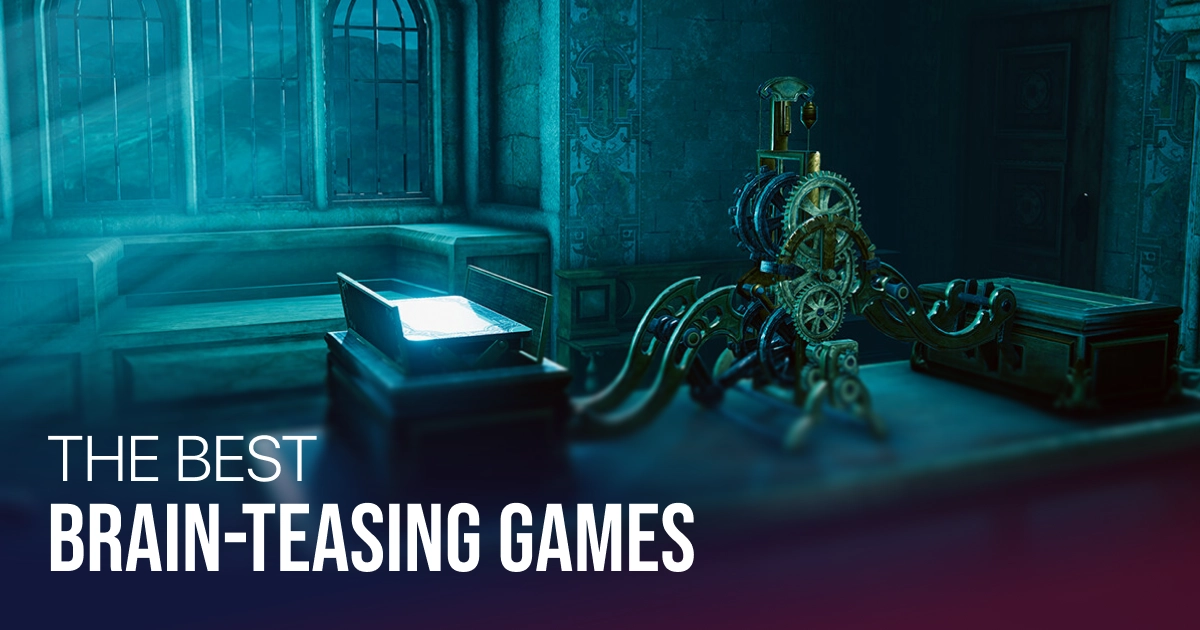
Not every game tests your reflexes, your aim, or your ability to survive yet another encounter with a massive boss. Some offer a far sneakier challenge: stop, look at what's happening from a different angle, and try to figure out what the hell is going on.
Puzzles are great because they force the player to find answers on their own. Standard tactics rarely help here, and the obvious solution often turns out to be wrong. Sometimes you need to connect several images, sometimes reconstruct the events of a crime, and occasionally make sense of how an entire universe works.
We've gathered games where riddles form the core of the experience. Some impress with original mechanics, others deliver a genuine intellectual challenge, and a few turn problem-solving into a pleasure all its own.
Gorogoa

Gorogoa turns ordinary illustrations into an intricate system of interconnected puzzles. You get several hand-drawn panels that you can move, combine, zoom in on, and layer over each other. Each image hides its own story, but the right combination opens up entirely new possibilities.
The game's defining trait is that there are almost no conventional hints. You have to study the details closely, spot connections between images, and understand how one space can transition into another. Gorogoa skips lengthy explanations and dialogue, letting the visuals tell the story on their own. It's a short but wonderfully weird adventure where even a simple picture can turn out to be part of a complex mechanism.
COCOON

COCOON builds its puzzles around a wild concept: entire worlds fit inside special spheres that the protagonist carries around. Each sphere is a separate reality with its own quirks, mechanisms, and possibilities.
Gradually you learn to use these worlds inside one another, opening up new routes and interacting with the environment. The riddles keep getting trickier, pushing you to remember each sphere's properties and combine them correctly. COCOON barely weighs you down with text, preferring to teach its rules through exploration and experimentation. The result is a journey where understanding the mechanics feels just as rewarding as discovering new locations.
The Rise of the Golden Idol

What happened at the crime scene? Who's responsible? Why are witnesses saying completely different things? The Rise of the Golden Idol asks you to work through a series of mysterious events on your own, piecing together information from the environment, documents, and character conversations.
You explore scenes, find important objects, and gradually fill in special diagrams to reconstruct the sequence of events. Noticing a suspicious detail isn't enough: you need to figure out how it connects to the rest of the evidence. A wrong theory can lead to a dead end, so you're constantly double-checking your own conclusions.
It's a great pick for fans of detective stories, logic puzzles, and the chance to feel like a real investigator. The game is in no hurry to show its cards either: some answers only become obvious once you've assembled a whole stack of tiny details.
The House of Da Vinci 3

Ancient mechanisms, secret rooms, enigmatic devices, and Renaissance-era inventions form the backbone of The House of Da Vinci 3. It's a first-person adventure puzzle game where you explore highly detailed locations and tinker with elaborate contraptions.
Most challenges revolve around machinery: finding hidden switches, placing elements in the right spots, unlocking locks, and activating unusual devices. Some riddles demand a close look at your surroundings, while others test spatial reasoning and your eye for small details.
The third installment continues Giacomo's story, so it's an especially good fit for anyone who enjoys adventures with a historical flavor. The real satisfaction comes from watching a complex mechanism finally come to life after several minutes of thought.
Hidden Through Time
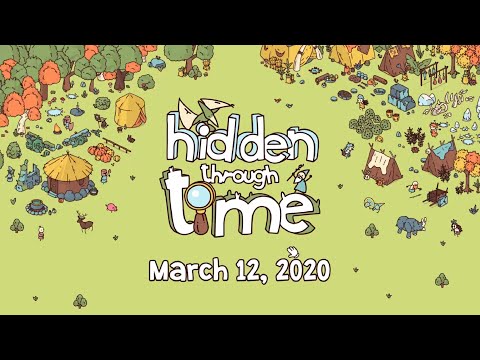
Sometimes solving a puzzle doesn't require complex formulas or multi-step mechanisms. You just need to look at the picture carefully. Hidden Through Time has you hunting for hidden objects and characters across colorful illustrations depicting different historical eras.
At first glance, the levels seem simple and even relaxing. But gradually, objects get more cleverly disguised among houses, trees, animals, and countless environmental details. Sometimes the item you need is right in front of your eyes, yet spotting it turns out to be harder than expected.
Hidden Through Time is perfect for short gaming sessions. You can step away from your day for a bit, sink into the search, and steadily check off every item on the list. And with the level editor and user-generated content, the possibilities for new challenges get even wider.
Maquette

Maquette offers an unusual spatial puzzle built on the principle of recursion. At the center of the game world sits a miniature model of the surrounding space, mirrored from the actual location. Things get interesting when you realize that changes inside the model can affect the larger world.
For example, a small object in the miniature can become a massive structure in the real environment. Using this quirk, you open passages, overcome obstacles, and find new ways to interact with the space.
The game also tells the story of a relationship between two people, slowly revealing it through the environment and the events taking place. Solving puzzles here becomes part of a more personal, emotional journey.
Unheard – Voices of Crime

What if you could investigate a crime without ever seeing it? In Unheard, you get to listen to recordings of conversations that took place in different rooms and reconstruct the events yourself.
Instead of the usual clue-hunting, you'll be tracking characters' voices, figuring out who's speaking, where they're moving, and who they're interacting with. Gradually, separate conversations form a bigger story, and phrases that seemed random at first start to take on a completely different meaning.
What makes Unheard special is that you have to do more than listen; you have to analyze. One missed conversation can completely change your understanding of what happened. It's an unconventional detective puzzle where your own attention is the main investigative tool.
Storyteller

Storyteller puts you in the director's chair for a series of short tales. You get a set of characters, locations, and events, and your job is to arrange them in special panels so the resulting story matches the given prompt.
For instance, you might need to tell a story about betrayal, love, revenge, or an unexpected rescue. It sounds simple: place the characters and see what happens. But every action has consequences, and changing a single panel can flip the entire plot on its head.
The game is especially fun because there are multiple ways to reach the goal. Sometimes the solution is surprising, and sometimes you have to rebuild the whole story several times to get the ending you need. Storyteller turns logic into a little creative exercise, where understanding how stories work matters as much as making the right moves.
Chinatris

Classic falling-block puzzles are familiar to almost everyone, but Chinatris reimagines the format through Chinese writing. Instead of standard geometric shapes, you work with components of Chinese characters that need to be combined correctly.
The goal is to assemble symbols using their component parts while following the rules of how characters are formed. The game demands attention as well as some understanding of how Chinese writing is structured.
Chinatris stands out from traditional puzzle games thanks to its theme and mechanics. It's a refreshing option for anyone tired of standard blocks, identical combinations, and endless line clearing.
Kaamos: Puzzle Roguelike

Kaamos: Puzzle Roguelike combines puzzle gameplay with roguelike elements. Finding a single solution isn't enough here: each run becomes a sequence of trials where you have to think through your moves and live with the consequences of your choices.
The game uses turn-based mechanics, so there's no rush. You can calmly analyze the situation, pick a sensible course of action, and try to find the most efficient way through each challenge. But the roguelike elements add unpredictability: the strategy that worked last time won't necessarily carry over to your next run.
Kaamos will appeal to anyone looking for something more demanding than classic puzzles. Logic becomes your main survival tool, and every fresh attempt gives you a reason to rethink your whole approach.
Conclusion
A good puzzle doesn't have to be insanely difficult. Sometimes one clever mechanic is enough to make you forget about everything else for a few hours. That's why the genre stays so diverse: some games have you exploring space, others push you to solve crimes, and a few turn problem-solving into genuine art.
This list has something for just about any mood. You can relax hunting for hidden objects in Hidden Through Time, test your deduction skills in The Rise of the Golden Idol, or lose yourself in the strange spatial experiments of COCOON and Maquette.
After all, the best part of a puzzle isn't even the solution itself. It's that moment when, after many attempts, everything suddenly clicks into place.