
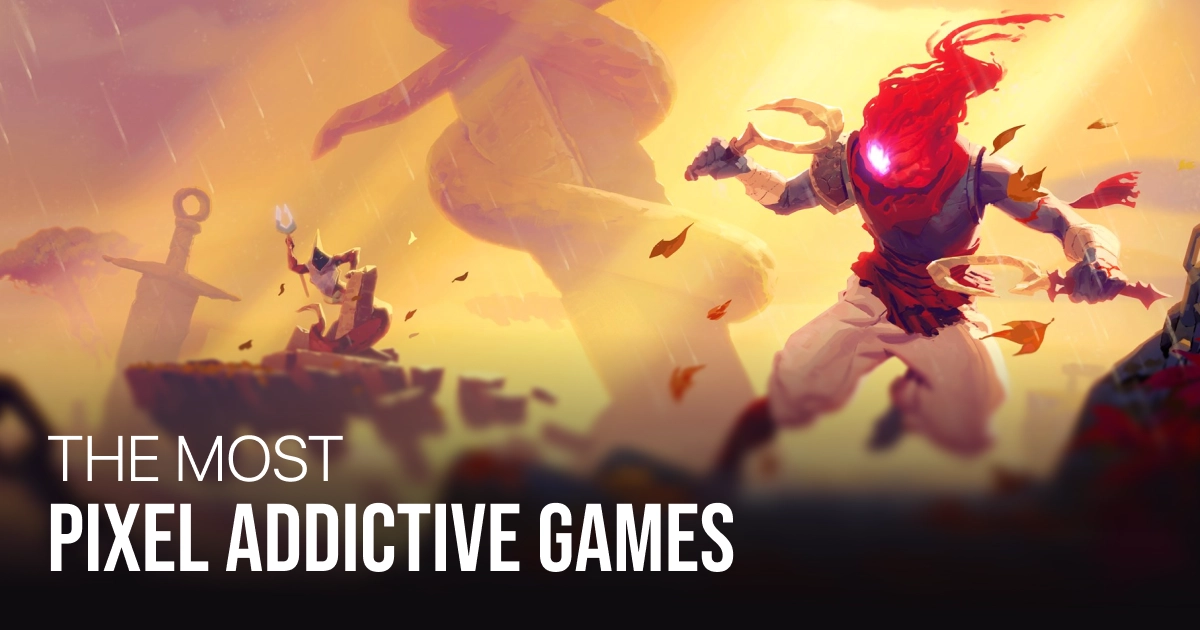
Introduction: The Magic of Pixel Art
Do you remember that sound when you inserted a cartridge into a Dendy or Sega? That click was a gateway to worlds woven from squares. Today, when GPU power is measured in teraflops, pixel art hasn't just survived. It has become a powerful aesthetic language that speaks to us directly, bypassing photorealism. The magic lies in this paradox: limitation gives birth to boundless imagination.
A pixel is not just a technical compromise of the past. It's a conscious artistic choice. It forces designers to be geniuses of minimalism: to convey sadness in a character's eyes with two or three squares, and a feeling of incredible speed with twelve frames of animation. Modern pixel games aren't just a "retro" stylization. They are a distillation of the very essence of gameplay interaction, where every detail on screen matters, and a special mood is born not from polygon counts, but from perfect composition, sound, and your imagination, which fills in these rough forms with incredible clarity.
On this journey through the best pixel worlds, we won't just list graphical tricks. We'll look at games that use this language for completely different purposes: from meditative creation to soul-chilling horror, from reflective Metroidvania to unrestrained fun. This is proof that pixel art is not a genre, but a whole universe of possibilities. Are you ready to dive back in?
Dead Cells: The Endless Dance of Death and Rebirth

Dead Cells is the gold standard for combining Metroidvania and roguelike. You play as a formless mass of cells that has taken over a prison guard's body, trying to escape from a plagued island.
The main thing here is the feel of the game. The controls are incredibly precise, and death becomes part of the learning process. After each attempt, you return to the beginning, keeping upgrades and blueprints. Procedurally generated levels, a changing arsenal, and enemies make each run different from the last.
And the ability to return to old locations with new abilities adds classic Metroidvania exploration. You will die again and again, but the perfect gameplay constantly makes you click "New Attempt."
Minecraft: The Sandbox Without Borders
You find yourself in an unknown world made entirely of cubes. There are no strict quests or instructions here — just an endless landscape and tools with which you create your own adventure.
The pixel aesthetic became the foundation of Minecraft. From simple blocks, you can build everything: from a small hut to the most complex mechanisms. For some, it's survival; for others, it's a construction set or a place to play with friends. You don't play through a ready-made story — you create it yourself.
Even after hundreds of hours, there's always a new place to explore, an idea for a build, or a reason to simply watch the sunset from the top of your own creation.
Sonic Origins: Speed and Nostalgia in Pixels

Sonic Origins is a true time machine for fans of the classics. The collection brings back the feel of the original games, preserving their 16-bit aesthetic, speed, and recognizable physics.
It includes Sonic 1, 2, 3 & Knuckles, and CD. The original soundtrack and gameplay are complemented by modern conveniences like save states and an art collection.
For a new generation, it's a great way to get acquainted with legendary games, and for veterans, it's a chance to feel like they're back in the Sega Mega Drive era.
Stardew Valley: The Coziness of Farm Life

Stardew Valley turns ordinary farm chores into a real ritual. You grow crops, tend to animals, fish, and gradually create your own cozy world.
But the farm is only part of the game. The town is home to characters with their own stories, and the mines hold monsters and rare resources. The game doesn't rush you and lets you choose your own pace: focus on farming, explore the mines, or socialize with the villagers.
The main pleasure is seeing the result of your efforts. Planted trees grow, relationships develop, and each new building or upgrade opens up additional possibilities. It's easy to lose track of time in Stardew Valley.
The Escapists 2: The Art of Escape

In The Escapists 2, you're not saving the world — you're an ordinary prisoner trying to escape from jail. To do this, you'll have to study the daily routine, search for useful items, craft tools, and distract the guards.
Pixel graphics are perfect for this kind of gameplay: all objects are easily distinguishable, and each prison turns into a complex puzzle. Mistakes lead to solitary confinement and loss of tools, forcing you to change your strategy.
It's especially fun to play in four-player co-op. Together you can create real chaos, distracting the guards while simultaneously plotting your path to freedom.
Rain World: Survival in a Harsh World
In Rain World, you are a small, vulnerable creature in a world of predators. Here you are not a hero, but potential prey. Any shadow or sound could mean danger.
The main mechanic is survival. You slide through pipes, search for shelter, and run from creatures that live by their own rules. Even the rain becomes a deadly timer, forcing you to find shelter in time.
The game requires patience and observation. When you finally learn the behavior of the local fauna and find a safe route, victory feels not like superiority over the game, but like a fragile truce with the surrounding world.
Blasphemous 2: A Grim Pilgrimage

Blasphemous 2 turns Metroidvania into a grim religious pilgrimage. The world is filled with distorted cathedrals, horrific creatures, and an atmosphere of religious nightmare. Death here becomes part of the path to understanding the world.
The combat system has become deeper thanks to three unique weapon types, each offering its own playstyle. Victory requires studying enemy attacks and choosing the right weapon.
The pixel art is particularly impressive. Distorted characters, monsters, and grim landscapes are reminiscent of medieval engravings and paintings by Goya or Dalí. This is a game for those who appreciate a harsh atmosphere and unusual aesthetics.
Bionic Bay: A Pixel Journey Through an Abandoned World

Bionic Bay transports the player to a world of abandoned technology, huge mechanisms, and mysterious ruins. To move forward, you'll have to explore the environment and understand its rules.
The main feature is interaction with the world's physics. Surrounding objects become part of puzzle-solving: you can use them for movement, overcoming obstacles, and finding unusual paths.
Sometimes a solution seems impossible until a small detail changes your understanding of the level.
DAVE THE DIVER: Adventures of a Diver and Sushi Chef

Dave the Diver combines completely different activities. During the day, you explore the Blue Hole, catch fish, and encounter dangerous creatures, and in the evening, you manage a sushi restaurant.
The main trick is the connection between these two occupations. Resources obtained underwater become ingredients for dishes, and successful trading allows you to upgrade the restaurant and equipment.
The game constantly changes pace: exploration, battles, restaurant management, and humorous events take turns. It's this unusual balance that makes Dave the Diver one of the most original pixel projects in recent years.
Darkwood: Survival Horror in the Forest

Darkwood builds horror not on jump scares, but on a constant feeling of vulnerability. In the dense forest, you can hardly see anything, and any sound could mean something dangerous approaching.
During the day, you explore the world, gather resources, and fortify your shelter. At night, you have to fend off creatures. Light becomes the main resource, and it can run out at the worst possible moment.
The main source of fear is the forest itself, the sound design, and the story you have to piece together from fragments. Darkwood isn't for everyone, but for fans of atmospheric horror, it's one of the genre's strongest representatives.